

More pressure, more effect?
The cough assistance device is set up, therapy is running, the displayed peak flow looks good. And yet secretions are only mobilised inadequately.
So what now? Increase the pressure?
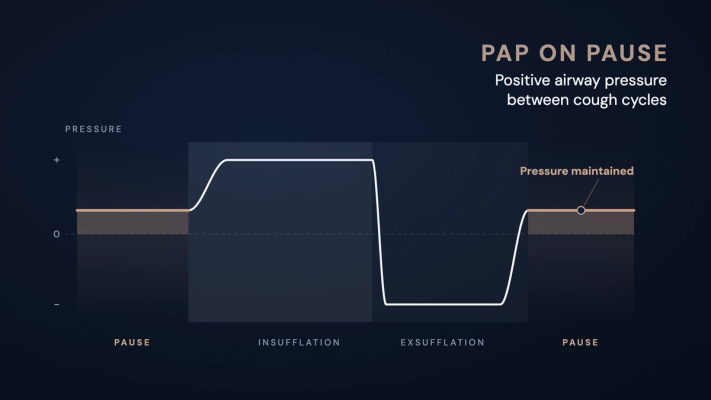
That thought is an obvious one. After all, MI-E is meant to support as effective a cough as possible. To do this, air is first delivered into the lungs under positive pressure. The subsequent rapid switch to negative pressure generates a high expiratory airflow intended to support secretion transport toward the central airways.
Higher pressures can increase this airflow. But whether this also makes the therapy more effective depends on further factors. [3]
What higher pressures actually achieve
A physiological comparison study examined 29 clinically stable patients with respiratory muscle weakness. The study group comprised ten patients with Duchenne muscular dystrophy, eight with spinal cord injury and eleven patients on long-term ventilation via tracheostomy.
Two different pressure settings were compared:
| **Low pressure** | vs. | **High pressure** |
|---|---|---|
| **+30/-30 cmH2O** | **+60/-60 cmH2O** | |
| **179 l/min** | **228 l/min** |
Mean cough peak flow (CPF) under low- and high-pressure MI-E [1]
The higher pressure setting produced a statistically significant increase in cough peak flow. For lung recruitment, neural respiratory drive and subjectively perceived dyspnoea, however, no significant differences were found between the two pressure settings. [1]
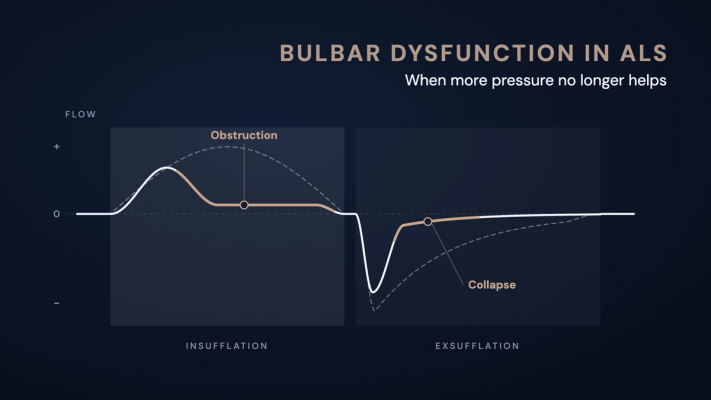
A more differentiated picture emerged, however, in patients with more pronounced respiratory muscle weakness. Under the higher pressure setting, they more frequently experienced upper airway closure. They also reported greater discomfort during therapy. [1]
This yields an important insight for individual pressure settings: a higher cough peak flow does not necessarily mean more effective cough assistance. Besides the measured flow, the physiological response and the tolerability of therapy should also be taken into account.
This does not mean that high pressures should generally be avoided. They can well be necessary and appropriate. What matters is whether the chosen setting produces a clinically demonstrable benefit in the individual patient and is well tolerated.
More pressure, more risk?
Increasing the pressure on the cough assist device is quickly done. But not every patient brings the same starting conditions. Particularly with pre-existing lung tissue damage, the question of possible risks also arises.
Two published case reports illustrate how important this consideration is: in these patients with neuromuscular disease, a pneumothorax occurred in temporal association with the use of MI-E and lung volume recruitment procedures, respectively. [5]
Such complications have so far only been documented in isolated cases, but they can have serious consequences. However, no direct relationship between the level of the set pressure and pneumothorax risk can be derived from this. Nor do these reports provide a generally valid pressure threshold above which application would be considered dangerous.
Chatwin and Wakeman list bullous emphysema, an undrained pneumothorax and recent barotrauma as contraindications. A prior pneumothorax, by contrast, is listed as a precaution. This classification is based, among other things, on the instructions for use of individual MI-E devices. [3]
If sudden chest pain, acute dyspnoea or unexplained respiratory deterioration occurs during or after application, MI-E must be interrupted and the patient assessed by a physician without delay. Pneumothorax should also be considered as a possible cause.
Why always +40/-40 cmH2O?
Pressure settings such as +40/-40 cmH2O are widespread in MI-E therapy and are also frequently described in the literature as a point of orientation. [3]
But do insufflation and exsufflation pressure actually always have to be set to the same level?
After all, the two pressure phases serve different purposes: insufflation is meant to deliver sufficient air into the lungs, while exsufflation serves to generate an effective airflow for secretion mobilisation.
A look at clinical care practice also shows that the two pressure values need not necessarily be identical.
A retrospective study published in 2025 analysed the MI-E settings of 359 adult patients. The median insufflation pressure was +35 cmH2O, while the median exsufflation pressure was -45 cmH2O. [2]
In this patient group, the negative pressure was therefore, in median magnitude, higher than the positive pressure.
These findings show that asymmetric pressure settings are indeed used in practice. However, they do not demonstrate that stronger exsufflation is generally more effective. The study describes the care practice of a single centre and does not provide a universally valid recommendation for an optimal pressure combination.
For individual therapy adjustment, a quite different question therefore arises: which phase of cough assistance actually needs improvement in this particular patient?
If insufflation is inadequate, this does not necessarily mean the exsufflation pressure also needs to be changed. Conversely, adjusting exsufflation does not automatically require increasing the positive pressure.
What matters is assessing the two therapy phases in a targeted way, rather than changing both pressure values together as a matter of course.
What if pressure is not the decisive factor?
Improving cough assistance does not always require changing pressure values. Insufflation time and inspiratory flow also influence how much air is delivered during insufflation. [3]
An adequate inspiratory volume is an important prerequisite for the subsequent cough. If too little air is delivered during insufflation, this does not necessarily result from a pressure that is too low. The insufflation phase may be too short, or relevant leaks may be present.
The speed at which air is delivered also deserves attention. Some patients find a fast inspiratory flow uncomfortable. A slower insufflation may be better tolerated in such cases. The insufflation time may need to be adjusted accordingly so that sufficient air still reaches the lungs. [3]
Interestingly, inspiratory flow may play a role not only for tolerability but possibly also for secretion transport.
An experimental study from 2018 compared different MI-E manoeuvres on a lung model. A slower insufflation produced a more favourable ratio between expiratory and inspiratory flow. Under these conditions, the simulated secretions were moved further toward the central airways than with the standard manoeuvre used for comparison. In the statistical analysis, however, maximum expiratory peak flow alone showed no significant association with the observed secretion displacement. [4]
Since these findings come from an experimental study, they cannot be directly transferred to clinical application. They do, however, illustrate that besides pressure, the timing and the ratio of airflows can also matter for cough assistance.
In practice, it is therefore worth not looking exclusively at pressure values when therapy effect is insufficient. Other settings, too, can offer starting points for individual adjustment. Which change is appropriate ultimately only becomes clear when the therapy effect is assessed in the patient.
Have you asked the patient?
We occupy ourselves with pressure values, flow curves and therapy times. But amid all these technical possibilities, a quite simple question can sometimes get lost: how does the patient actually experience the therapy?
Not every inadequate cough assistance can be recognised from a measured value. And not every setting that looks good on the display feels good to the patient.
Even a few targeted questions can provide valuable clues. Does the air feel comfortable, or is the inspiratory flow too fast? Does the patient feel they are getting enough air before exsufflation begins? Is the cough uncomfortable, or does the patient simply need more time to recover between cycles?
Sometimes it is precisely these apparent small details that make the difference.
If a patient reports, for instance, that the inhalation phase is too short, it is worth first looking at the insufflation time before increasing the positive pressure. If exsufflation feels burdensome to the patient, the negative pressure, the exsufflation time and the clinical response should be reviewed.
Of course, objective measured values remain important. They help us assess therapy and make changes traceable. But they replace neither clinical observation nor conversation with the patient. [3]
Not every patient can communicate their perceptions verbally. Particularly where communication is limited, attentive observation, alternative means of communication and, where appropriate, involving familiar caregivers become especially important.
What ultimately matters is what a change achieves for the patient: Is therapy better tolerated? Can secretions be mobilised more effectively? Does the application feel less burdensome?
Sometimes a better therapy setting begins not with the next button press on the device, but with a simple question to the patient.
Established, or just familiar?
A patient has been using their cough assist device for several years. The settings are known, application is routine, and so far everything has worked well. So why change anything?
Because things may well have changed in the meantime.
Particularly with progressive neuromuscular disease, the demands on effective cough assistance can increase. Respiratory muscle weakness may be worsening, respiratory mechanics may be changing, or secretion mobilisation may be becoming increasingly difficult. Tolerability of therapy can also decline as the disease progresses.
This does not mean, of course, that every established setting is fundamentally wrong. But if cough assistance no longer produces the desired effect, it is worth taking a closer look.
Is insufflation still sufficient? Does the cough match the current situation? Or could different pressure settings, altered therapy times or an adjusted inspiratory flow improve the application?
Sometimes this confirms that the existing settings remain well suited. And that, too, is a valuable outcome.
The literature describes both standardised and individually adapted approaches to MI-E. What matters, however, is repeatedly reviewing the therapy effect over time and responding to changes as needed. [3]
Just because we have been using a setting for years does not mean it is still the right one today.
What do we know, and what remains open?
The studies available so far provide important insights. What they do not provide, however, is a universally valid answer as to which pressure setting is right for every patient.
The high-pressure/low-pressure study, for instance, examined only 29 clinically stable patients. The focus was on short-term physiological responses. Whether the different pressure settings have a long-term effect on actual secretion mobilisation, respiratory infections or hospitalisations remains open. In addition, insufflation and exsufflation pressure were changed simultaneously, so the effects of the individual pressure phases cannot be clearly distinguished from one another. [1]
The other studies, too, do not provide universally valid rules for settings. While the analysis of 359 patients describes the care practice of a single centre, the findings on optimised inspiratory flow come from an experimental study on a lung model. [2,4]
Does that mean these studies are of little use in practice? Quite the opposite.
They help us better understand physiological relationships, question familiar approaches and make therapy decisions more deliberately.
What ultimately counts?
So how much pressure does effective cough assistance really need? There is no single right number.
The best setting is not necessarily the one with the highest pressure, but the one that works best for the patient.
Questions about practical application of MI-E?
Do you work with cough assist devices and want more confidence in individually adjusting MI-E? Would you like to align pressure settings, therapy times and inspiratory flow more precisely with your patients' needs?
Feel free to get in touch. We can help you organise hands-on training or put you in contact with a local partner to discuss questions on application and individual therapy adjustment together.
Where this article deviates from the manual, the manual applies. Information on selecting settings does not replace clinical decision-making.
Sources
Note
This article is provided for professional information and does not replace clinical judgement. Statements on device settings are orientation only; the device's instructions for use and the assessment of the treating clinician prevail.