BiWaze® Cough uses a dual-turbine system that technically separates inspiration and expiration—for more precise flow and oscillation performance, as well as an expiratory trigger that facilitates titration and enables complete synchronization with the patient's breathing

Inspiratory trigger and CoughCue follow the patient's natural breathing rhythm – not the other way around.

A controlled pressure ramp reduces inspiratory flow and increases peak cough flow – for more effective secretion transport.

Two independent blowers fully separate inhaled and exhaled airflow – no mixing, no cross-contamination.

Weighing just 4 kg with an integrated battery – ready for use in hospital and home care.

Pressure and timing can be set individually for each cycle – tailored to the patient's tolerance.

Reduced submenus, clear user guidance – quick setup in everyday clinical practice.
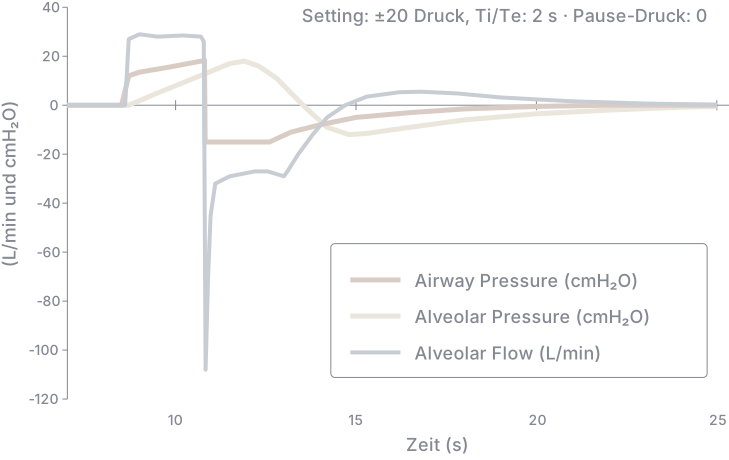
BiWaze Cough® provides a plateau-shaped flow curve that builds up greater preload, thereby helping to achieve higher expiratory flow rates (PCF). In addition, patient comfort is enhanced by a more physiological inhalation pattern.

The inspiratory trigger detects the patient’s natural inhalation effort and only then initiates the therapy cycle—with ten adjustable sensitivity levels. This allows the patient to determine when inhalation begins, rather than having it dictated by the device.

CoughCue applies the same level of control to the transition from inhalation to coughing: The device detects the natural end of inhalation—using a flow or pressure threshold—and switches to the exhalation/coughing phase exactly when the patient is ready.

Many patients perceive cough therapy as a loss of control—the device dictates the rhythm, not the patient. Inspiratory Trigger and CoughCue reverse this: inhalation, exhalation, and pauses follow the patient’s natural breathing rhythm. The result is not only greater comfort but also genuine confidence in the therapy.
The most important feature of the BiWaze® Cough is its two separate turbines, which also completely isolate the internal airflows from one another. The dual turbine control system allows for more precise control and provides a more comfortable and effective therapy.
Another notable feature of the BiWaze® Cough Assist is the positive-pressure pause phase, which can be set between cough cycles.
| Operating temperature | 5–35 °C |
|---|---|
| Relative humidity | 15 to 95% (non-condensing) |
| Dimensions | 27.5 × 23.5 × 9.0 cm |
| Weight | 4.1 kg (incl. battery) |
| Modes | Auto / Manual |
| Maximum positive pressure | 70 cm H₂O |
| Maximum negative pressure | -70 cm H₂O |
| Maximum pause pressure | 15 cm H₂O |
| Inspiration time | 0 - 5 Sec. (only in Auto mode) |
| Expiration time | 0 - 5 Sec. (only in Auto mode) |
| Pause time | 0 - 5 Sec. (only in Auto mode) |
| Inspiration flow ramp | Low, Medium, High |
| Inspiratory trigger sensitivity | 1 – 10 |
| Oscillation frequency | 5 – 20 Hz |
| Amplitude | 1 – 5 |
A cough assist device helps people with a weakened cough clear secretions from the airways. BiWaze Cough uses mechanical insufflation-exsufflation: it fills the lungs with positive pressure and then rapidly switches to negative pressure to mimic a natural cough.
For patients with a reduced cough, for example due to neuromuscular conditions, and wherever secretions cannot be cleared adequately – in the clinic and in home care.
Yes. BiWaze Cough is designed for both clinical and home use and can be used at home after appropriate instruction.

One circuit, two paths: the Dual Lumen Breathing Circuit for BiWaze Cough & BiWaze Clear separates inhaled and exhaled air within a single set. This article explains what that means for everyday use at the device.
September 28, 2026
CoughCue detects the moment the lungs are full on the BiWaze Cough and starts exsufflation exactly then. How the two trigger types work, what the inspiratory hold time does, and how CoughCue differs from the inspiratory trigger.
August 7, 2026