


Why the switching point decides how well therapy works
Mechanical insufflation-exsufflation imitates a cough: the device fills the lungs with positive pressure, then abruptly reverses that pressure to carry secretions out of the airways. How well this works depends not only on the pressures set and the flows they produce, but on when the switch happens.
A natural cough begins at the end of a deep breath in — when the lungs are at their fullest (zero flow) and the diaphragm turns into the expiratory movement. Switch too early and the lungs are not adequately filled. Switch too late and the patient works against the device.
A fixed inspiratory time takes away the patient’s flexibility to shape that moment individually. This is where CoughCue comes in.
What CoughCue does
CoughCue synchronises the expiratory phase of the BiWaze Cough with the patient’s natural breathing. The device detects the point at which the lungs are full (zero flow) and switches to exsufflation then, instead of waiting out a fixed time. The aim is a more comfortable and stronger cough.
It identifies that full state from one of two signals: a drop in inspiratory flow, or a pressure plateau. Which one counts is set by the trigger type.
The function is available in automatic mode only and is disabled by default.
The therapy cycle with CoughCue enabled
In automatic mode the device repeats this three-phase cycle until the user interrupts therapy or the programmed number of cycles is reached.
-
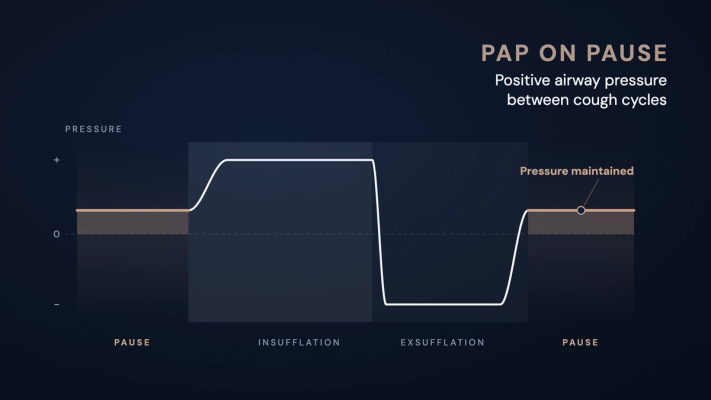
Pause phase
The device maintains the programmed pause pressure for the set pause time — or, with the inspiratory trigger enabled, lets the patient initiate inspiration themselves.
-
Inspiratory phase
The device builds positive pressure towards the target inspiratory pressure and flow. It switches as soon as one of these events occurs:
- inspiratory flow drops to the selected CoughCue threshold (flow trigger), or
- the target pressure is reached (pressure trigger).
Where an inspiratory hold is clinically indicated, the device only switches to exsufflation once the hold time has elapsed. The patient then holds the breath briefly against the applied pressure — comparable to glottic closure in a natural cough — making fuller use of the lungs’ elastic recoil.
-
Expiratory phase
The device applies the programmed expiratory pressure for the set expiratory time.
The two trigger types
On the device this setting is called CoughCue Type.
Flow based
When inspiratory flow peaks and then falls, the device tracks that decline. The threshold is selectable: 50 % or 0 % of peak inspiratory flow. Once flow reaches the selected value, the expiratory phase begins.
The switch therefore follows diaphragm movement. The manual describes the result as a maximised peak expiratory flow; at the same time, the synchronisation reduces the risk of asynchrony.
Pressure based
Here the device monitors airway pressure. When it stabilises at the set inspiratory pressure — the pressure plateau — the device reads this as full lung inflation and switches to exsufflation.
Which type when?
The flow based variant follows the patient’s respiratory mechanics. A threshold of 0 % waits for inspiratory flow to fall away completely and therefore aims at a near-complete filling of the lungs; at 50 % the device switches earlier, which is more likely to suit a patient showing spontaneous effort.
The pressure based variant keys off a purely technical value and is therefore less dependent on patient participation. Bear in mind that reaching the target pressure does not necessarily equate to a well-filled lung. The choice rests with the treating clinician, based on the clinical picture.
Inspiratory hold time: the fine adjustment
After the trigger, the device can hold inspiratory pressure briefly before switching. This inspiratory hold time is adjustable from 0 to 2 seconds in steps of 0.1 seconds.
It is the dial between two aims that can pull against each other: a longer hold allows fuller lung expansion and therefore potentially more recruitment; a shorter hold is more comfortable for the patient. The setting is therefore a balance between lung expansion and patient comfort.
Even at maximum hold time, the 5-second limit on the inspiratory phase still applies.
CoughCue is not the inspiratory trigger
Both functions synchronise with the patient, but at opposite ends of the breath — which is why they are easily confused.
- The inspiratory trigger — labelled “Inspiratory Trigger” on the device — starts inspiration. During the pause phase the device waits for an inspiratory effort from the patient and only then begins building pressure. It monitors inspiratory flow every 16 milliseconds and offers ten sensitivity levels.
- CoughCue ends inspiration and can therefore be regarded as an expiratory trigger, though without a classic trigger threshold. It decides when the lungs are full enough and initiates exsufflation.
The two are not mutually exclusive. Enabling both leaves the start of the cycle to the patient and the detection of the switching point to the device.
Source: BiWaze® Cough User Manual, BC22463 Rev 12.0, sections 3.1, 3.2.1 to 3.2.3 and 11.1 (principle of operation). Where this article and the manual differ, the manual applies. Guidance on choosing settings does not replace a clinical decision.
Frequently asked questions
Does the patient have to participate for CoughCue to work?
Not with the pressure based trigger — it evaluates airway pressure alone. The flow based trigger follows the course of inspiratory flow and therefore needs an interpretable flow pattern. This is distinct from the inspiratory trigger, which does require an inspiratory effort and pauses therapy if none is detected for 30 seconds.
What happens if the CoughCue trigger is never detected?
The inspiratory phase ends regardless. The system switches to exsufflation after 5 seconds at the latest, or after the combined inspiratory time and inspiratory hold time — whichever occurs first.
Can I use CoughCue and the inspiratory trigger at the same time?
Yes. The inspiratory trigger determines when inspiration starts, CoughCue when it ends. Note that with CoughCue enabled, oscillations during the pause and inspiratory phases are switched off automatically.
Should I choose a flow threshold of 50 % or 0 %?
The manual gives no recommendation and leaves the choice to the treating clinician. As a guide: 0 % waits for inspiratory flow to fall away completely and aims at a near-complete filling of the lungs; 50 % switches earlier and is more likely to suit a patient showing spontaneous effort. The decision is part of individual therapy setup and should be verified with the patient.