


The problem between two cough strokes
Mechanical insufflation-exsufflation (MI-E, a technique that uses positive then negative pressure to simulate a cough) works in cycles. On the BiWaze Cough, each cycle consists of three phases: a pause, the insufflation, in which air is delivered into the lungs under positive pressure, and the exsufflation, for which the device switches immediately to negative pressure to draw out air and secretions [1]. A treatment usually consists of several such cycles in succession, separated by the pauses [1].
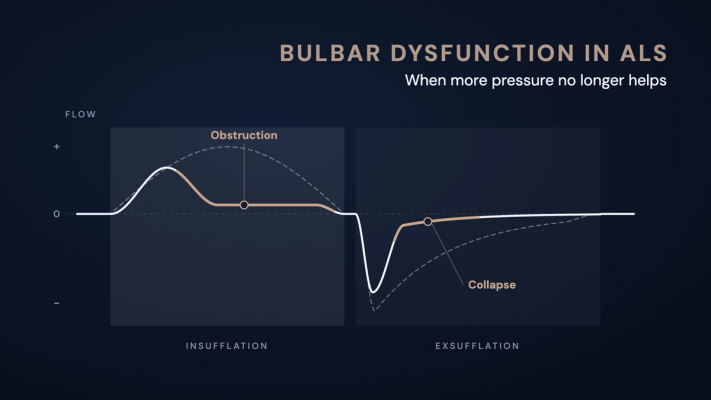
In practical use, this pause is more than a technical footnote. If the pressure falls back to ambient pressure between two cough strokes, the lungs can briefly lose volume even before the next insufflation begins. For patients with limited respiratory muscle function, for example in neuromuscular disease, this is not an incidental side effect.
For exactly this phase, the BiWaze Cough offers the "PAP on Pause" function (PAP: positive airway pressure) [1][2]. With it, a positive airway pressure is maintained during the pause between cough cycles.
What the function does
The BiWaze Cough maintains a positive airway pressure during the pause between two cough cycles [1]. This is intended to stabilise lung volume between cough strokes and avoid an unnecessary drop in lung volume [2].
Technically, this is made possible by a dual-blower system: two separate blowers independently generate the positive and the negative airflow [1]. Because positive and negative pressure do not come from one and the same blower, the pressure during the pause can be held in a targeted way [2].
A bench study conducted by the manufacturer on a technical model also describes a consistent oscillation (a fluctuation of pressure and flow) across the therapy cycle, both during insufflation and during exsufflation [2]. This statement comes from the bench measurement and should be read as a mechanism, not as a proven clinical effect on patients.
For secretion mobilisation, such continuous changes in pressure and flow are of interest: repeated mechanical impulses can act on the secretion and affect its flow properties. Thixotropy, a property by which thick secretion temporarily becomes more liquid through repeated movement, is discussed as a possible mechanism for this. It has not been investigated for the BiWaze Cough itself; this is a physiological consideration, not a manufacturer claim.
What is visible and adjustable at the device
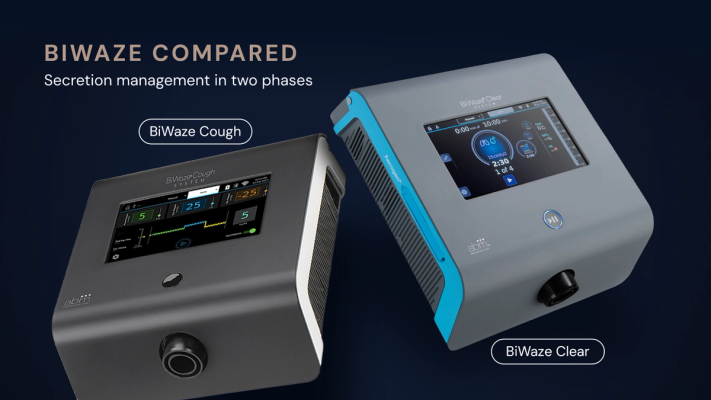
On the BiWaze Cough's touchscreen, the three phases of the cycle, pause, insufflation and exsufflation, are displayed with their pressure and time values [1]. This also makes the pause between cough cycles visible and traceable.
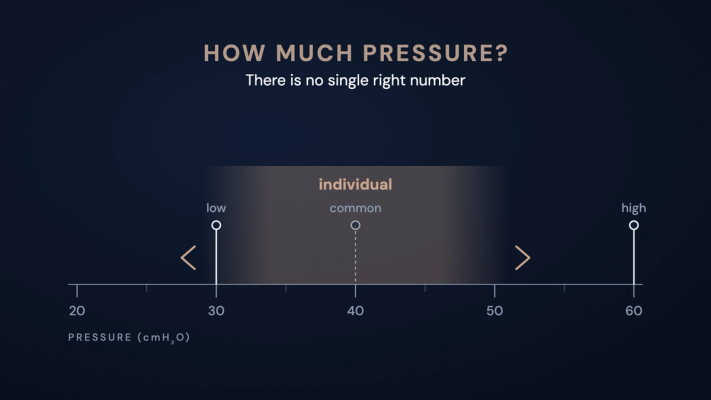
Pause pressure (0 to 15 cmH₂O) and pause time (0 to 5 seconds, in Auto mode) are adjustable [1]. If the inspiratory trigger is active, it replaces the fixed pause time: during the pause, the device waits until the patient inhales on their own, and only then starts the insufflation [1]. Which values are appropriate in an individual case is not something the user manual prescribes across the board. What matters are the goal of the therapy as well as the individual patient's response and tolerance.
Why this is not just about comfort
The focus of this function is not comfort but respiratory mechanics: by maintaining a positive pressure during the pause, lung volume between cough strokes is meant to be stabilised and an abrupt drop in pressure avoided [1][2]. A steadier pressure course can also contribute to a more comfortable perception of the therapy.
PAP on Pause does not replace any of the other settings, it supplements them. Inspiratory and expiratory pressure, the timing of the individual phases, and the oscillation remain the central parameters that determine the individual therapy outcome. The pause function acts exclusively during the pause between cough cycles.
What BiWaze Cough does not promise
The documentation describes this function as supporting the stabilisation of lung volume between cough strokes, not as a guarantee of a particular treatment outcome [1]. Nor does the pause function replace the treatment team's assessment of whether MI-E is indicated at all for a given patient. According to its indication, the BiWaze Cough is intended for patients who, because of a reduced cough stroke, cannot cough effectively or cannot clear secretions, for example with high-level spinal cord injury, neuromuscular disease or severe exhaustion due to lung disease [1]. The decision on use and settings remains with the treating clinician.
If this article differs from the manual, the manual applies. Information on selecting settings does not replace a clinical decision.
Frequently asked questions
Does PAP on Pause need to be active for every patient?
The user manual gives no blanket rule for every case of use; the pause pressure can be set from 0 to 15 cmH₂O [1]. Whether and how the pause phase is integrated into the individual therapy programme is decided by the prescribing clinician according to the patient's situation and the therapy goal.
Does the pause change the duration of the whole cycle?
Yes, the pause time is its own setting (0 to 5 seconds in Auto mode) and counts toward the duration of each cycle [1]. With the inspiratory trigger active, however, the pause is instead governed by the patient's own inhalation. The total duration of a treatment results from the individually set times and the number of cycles.
Is this the same as CoughCue?
No. PAP on Pause describes the pressure during the pause between cough cycles. CoughCue serves to synchronise the therapy with the patient's breathing. Both functions belong to the same device but pursue different goals.
Can I read the effect of the pause off the display?
The running phase of the therapy cycle and the corresponding pressure course are visible on the touchscreen. However, this does not show whether the held pause actually achieves the desired therapeutic effect in a given patient. For that, clinical observation and individual assessment of the patient remain decisive.
Sources
[1] BiWaze Cough User Manual (EU, multilingual), Abschnitte zu Therapiezyklus, PAP on Pause, Dual-Blower-System und Indikation
Note
This article is provided for professional information and does not replace clinical judgement. Statements on device settings are orientation only; the device's instructions for use and the assessment of the treating clinician prevail.