


1. The airflow makes the difference
What actually moves secretions along? In the airways, secretion sits as a viscous layer on the mucosa. Air flowing past it exerts what are known as shear forces at the secretion surface. Put simply: the passing air attempts to drag the mucus along in its direction of flow. If these forces are large enough to overcome the secretion's resistance, it can shift along the airway wall.
This interplay is referred to as two-phase transport: the flowing air as the gas phase and the secretion as the liquid phase influence one another at their shared interface [1, 2].
Oscillations can additionally alter the flow properties of the secretion and thereby facilitate its mobilisation [9]. But where it is subsequently transported depends on how the peak flows during inhalation and exhalation relate to one another. If both are approximately equal, the secretion may move back and forth without making meaningful progress toward the larynx. If expiratory peak flow predominates sufficiently, however, transport in that direction is favoured [2, 3].
The secretion itself also plays a role: its viscosity, elasticity, and the thickness of the secretion layer influence how readily it can be carried along by the airflow [1, 2].
2. The difference is what counts, but how large must it be?
Experimental studies provide two important orientation values for this [2, 3]:
| Parameter | Experimental threshold | Source |
|---|---|---|
| PIF/PEF ratio | Below 0.9, inspiratory peak flow is less than 90% of expiratory peak flow | [2] |
| PEF − PIF (difference) | Above 17 L/min | [3, 4] |
These values describe experimental conditions that can favour directional secretion transport. They are not, however, universally valid clinical thresholds [2–4].
Studies on test lung models show: depending on the ratio between inspiratory and expiratory flow, the secretion simulant moved either toward the airway opening or deeper into the test lung [3].
One bench study on manual hyperinflation illustrates this particularly clearly. Initially, the secretion simulant was transported deeper into the test lung by the standard technique using a resuscitation bag. After brief instruction, the operators changed their technique: they allowed air to flow in more slowly, held a brief inspiratory pause, and then allowed rapid passive exhalation. This produced a more favourable expiratory flow bias, and the secretion simulant then moved toward the airway opening [6]. The study, however, involved only twelve physiotherapists.
3. When airflow becomes the opponent
A look at ventilation practice is surprising: in 19 of 20 invasively ventilated adults studied, inspiratory peak flow exceeded expiratory peak flow by at least 10%. In eight of them, the mean difference was at least 17 L/min, in favour of inspiration [4].
Experimental studies show that such an inspiratory flow bias can favour secretion transport deeper into the airways [2, 3]. Whether this actually occurred in the patients studied was not investigated, however [4]. The study also relates to invasive ventilation, not to oscillation devices. Still, it illustrates a crucial relationship: airflow movement alone is not what counts, but rather the ratio between inspiratory and expiratory peak flow.
4. Who actually controls exhalation?
Inspiratory flow can be controlled in a targeted, technical manner. Passive exhalation is different: here, it is mainly the elastic recoil forces of the lung and chest wall, along with airway resistance, that determine how quickly air flows back out [5].
This is precisely where the challenge lies for oscillation devices. Systems that only actively generate pressure or flow during inspiration have only limited influence on expiratory flow. Particularly with pronounced airway obstruction, such as in COPD, this can make it difficult to achieve a favourable expiratory flow bias [5, 7].
A different technical approach therefore targets exhalation specifically: separate blowers for inspiration and expiration allow pressure delivery to be actively controlled during exhalation as well [7]. What matters, however, is not only what the technology makes possible, but which flow bias actually results, and that can be measured [7].
Yet active expiration also has its limits. With pronounced expiratory flow limitation or unstable airways, expiratory flow cannot be increased indefinitely. Settings must therefore always be adapted to the individual patient's lung mechanics.
5. Two blowers, one decisive difference?
Two blowers instead of one, at first that sounds like a technical detail. But what difference does it make for expiratory flow bias? This is exactly the question a bench study by Seattle Children's Hospital set out to answer [7].
Two different oscillation systems were compared: BiWaze Clear, with two separate blowers for inspiration and expiration and a closed coaxial tubing system with separate flow paths, versus a comparison system that operates with a single blower and an open tubing system with a leak valve [7].
The separate flow paths and active pressure delivery allow a higher expiratory than inspiratory peak flow to arise during oscillation [7]. The patient does not need to consciously exhale with particular force or speed for this. In the lung model, the measured flow bias arose from the interplay between the oscillation generated by the device and the simulated breathing patterns. How pronounced this effect is in an individual patient, however, also depends on their lung mechanics and the chosen settings [7].
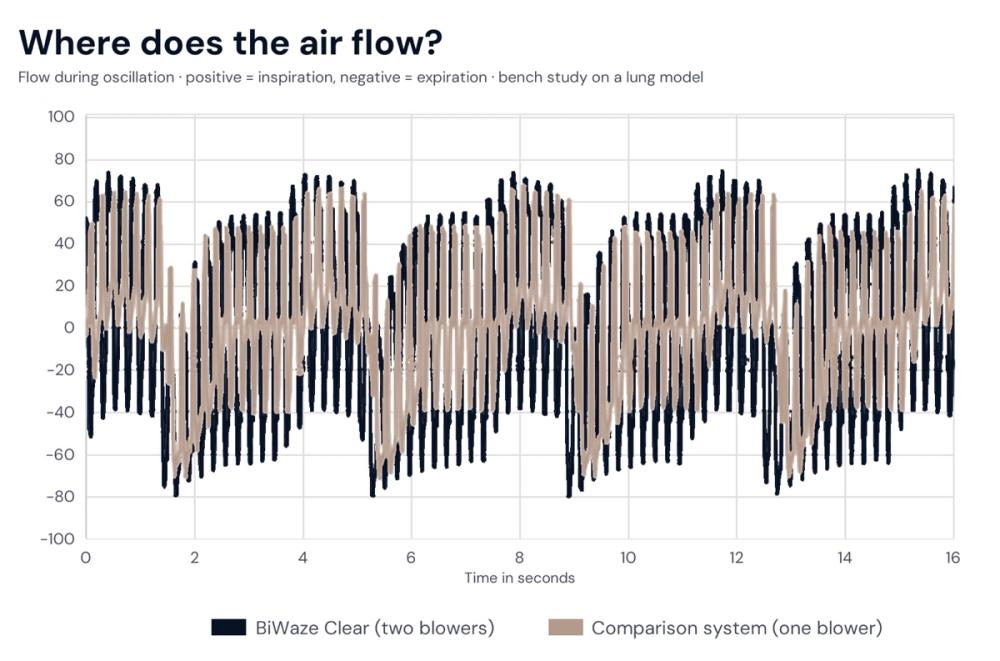
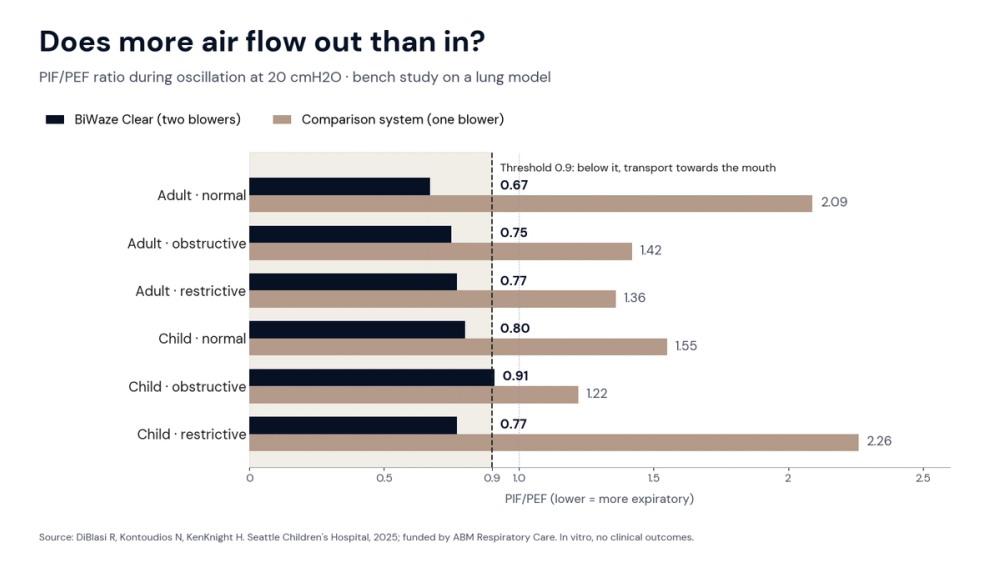
Mean tracheal measurements from the bench study [7]:
| Lung model | PIF/PEF BiWaze Clear (20 / 30 cmH₂O) | PIF/PEF comparison system (20 / 30 cmH₂O) | PEF − PIF BiWaze Clear, L/min (20 / 30) |
|---|---|---|---|
| Adult, normal | 0.67 / 0.68 | 2.09 / 2.37 | 32.4 / 37.5 |
| Adult, obstructive | 0.75 / 0.83 | 1.42 / 1.52 | 14.7 / 13.0 |
| Adult, restrictive | 0.77 / 0.72 | 1.36 / 2.13 | 16.7 / 24.8 |
| Child, normal | 0.80 / 0.81 | 1.55 / 1.42 | 6.8 / 8.5 |
| Child, obstructive | 0.91 / 0.87 | 1.22 / 1.18 | 3.4 / 6.4 |
| Child, restrictive | 0.77 / 0.74 | 2.26 / 2.25 | 9.7 / 13.4 |
What the measurements reveal
The difference is marked: BiWaze Clear produced a higher expiratory than inspiratory peak flow under all twelve conditions tested. In eleven of twelve measurement configurations, the PIF/PEF ratio was even below the experimental orientation value of 0.9. Only in the obstructive child model at 20 cmH₂O was it slightly above, at 0.91. The comparison system, by contrast, showed a PIF/PEF ratio above 1.0 in all twelve configurations [7].
A favourable flow ratio is not everything, however. BiWaze Clear reached the experimental orientation value for the difference, more than 17 L/min, in both normal adult models and in the restrictive adult model at 30 cmH₂O [7].
With obstructive lung mechanics in particular, this difference remained below that value. Increased airway resistance can limit expiratory flow, so more pressure does not automatically mean more expiratory flow. Notably, BiWaze Clear still produced an expiratory flow bias under these conditions, while the comparison system continued to show predominant inspiratory peak flow [7]. The flow differences measured in the child models were also markedly smaller; the 17 L/min orientation value cannot simply be applied to children [3, 7].
The measurements thus show a clear technical difference between the systems studied, with the overall device design, including tubing configuration, pressure delivery, and active control of expiration, playing a role [7].
What does this mean for practical application?
BiWaze Clear combines three therapeutic modalities that can be individually coordinated: PEP therapy, oscillation, and nebulisation [8]. PEP therapy can help stabilise the airways and support lung expansion. During oscillation, pressure and flow oscillations are intended to mobilise secretions. At the same time, active pressure delivery can produce an expiratory flow bias [7, 8]. Depending on the inhalation solution used, nebulisation can support secretion hydration and thereby ease expectoration [10].
There is no fixed setting value for a favourable flow bias. What matters is which flow profile actually results under the chosen settings, and this also depends on the individual patient's lung mechanics and breathing pattern [7].
Amid all the enthusiasm for technical possibilities, one thing must not be lost from view: the patient. What good is the most favourable flow profile if the patient does not tolerate the therapy?
6. What the measurements do not reveal
The results from the lung model are promising and invite further interest. Yet one crucial question remains: does this actually improve secretion progress in the patient?
The experimental thresholds for expiratory flow bias come predominantly from bench studies and studies on invasive ventilation [1–4, 6]. The device comparison, too, measured pressure and flow, not actual secretion movement [7]. Whether these results transfer to spontaneously breathing patients using a mouthpiece or mask, and whether secretion clearance is actually improved as a result, still needs to be investigated clinically.
Get to know the technology yourself
The measurements invite curiosity, but what does this look like in practical application? Curious to find out more? Then get to know the technology yourself! Contact us. We will be glad to introduce you to BiWaze Clear through a product demonstration and show you the various setting and therapy options, including a hands-on training session on request.
Frequently asked questions
What is an expiratory flow bias?
An expiratory flow bias arises when peak flow during exhalation (PEF) is higher than during inhalation (PIF). A sufficiently pronounced difference can support secretion transport toward the central airways. What matters, then, is not just that air moves, but which flow direction predominates [1, 2].
Is oscillation therapy alone sufficient to remove secretions from the lungs?
Not necessarily. Oscillations can mobilise secretions and influence their flow properties. But mobilised is far from the same as cleared. A favourable expiratory flow bias can support directional secretion transport. Actual secretion removal may additionally require huffing, coughing, or other suitable airway clearance techniques [2, 3, 9].
Which PIF/PEF ratio favours secretion transport?
Experimental studies describe a PIF/PEF ratio below 0.9, or a difference between expiratory and inspiratory peak flow of more than 17 L/min, as favourable conditions for secretion transport toward the airway opening [2, 3]. These thresholds, however, come predominantly from model studies and are not universally valid clinical therapy targets.
How does BiWaze Clear produce an expiratory flow bias?
BiWaze Clear uses two separate blowers and a coaxial tubing system with separate flow paths. This allows pressure delivery to be actively controlled during expiration as well. In the lung model studied, a higher expiratory than inspiratory peak flow arose during oscillation under all conditions tested [7].
Is an expiratory flow bias possible in COPD and obstructive airways too?
Yes, in principle an expiratory flow bias can also arise with obstructive lung mechanics. However, increased airway resistance and expiratory flow limitation can limit the achievable flow speeds. In the bench study, BiWaze Clear produced an expiratory-dominant flow profile even in the obstructive adult model. Whether this translates into a clinical benefit needs to be assessed individually [7].
How can PEP therapy, oscillation, and nebulisation be combined with BiWaze Clear?
BiWaze Clear allows PEP therapy, oscillation, and nebulisation to be combined individually. Pressure, oscillation frequency, and therapy duration can be adjusted and saved as a therapy profile. Nebulisation can be used supplementarily or separately, depending on the therapy goal. What ultimately matters is the individual patient's lung mechanics, therapy goal, and the effect and tolerability experienced by the patient [8].
Sources
Note
This article is provided for professional information and does not replace clinical judgement. Statements on device settings are orientation only; the device's instructions for use and the assessment of the treating clinician prevail.