


The mix-up that happens at the bedside
In everyday ward life, devices for secretion management are quickly lumped together as "something that helps with coughing". That's understandable, but imprecise, and it can lead to picking the wrong device. BiWaze Cough and BiWaze Clear both sit in Porta Medical's secretion-management portfolio, but they follow different mechanisms of action. Put a patient with a purely muscular cough deficit on a lung-expansion device, or vice versa, and you miss the actual problem.
This article puts the two mechanisms side by side, as described in their respective user manuals and the technical comparison study, and shows how to tell at the bedside which device fits the situation.
BiWaze Cough: support when the cough itself is missing
What you do at the device: You select the MI-E cycle (mechanical insufflation-exsufflation, the stepwise blowing in and then rapid suctioning out of air) and start it when the patient can no longer generate an effective cough on their own.
Why it works: According to the user manual, BiWaze Cough is intended for patients who cannot cough or clear secretions effectively because their peak cough flow is reduced, for example due to high-level spinal cord injury, neuromuscular disease or severe exhaustion from lung disease [1]. The device works on the MI-E principle: it gradually builds up positive pressure in the airways (insufflation, blowing air in) and then rapidly switches to negative pressure (exsufflation, actively drawing air out) [1]. This rapid pressure switch mechanically simulates what a forceful cough would achieve physiologically: secretions are moved from the lower airways toward the mouth.
Technically, BiWaze Cough uses two separate blowers: one drives the inspiratory flow, the other the expiratory flow [2]. The tubing is a separate matter: as standard, a single-limb tube is used. Anyone who also wants to keep inhaled air and coughed-up secretions separate within the tubing itself uses the Dual Lumen Breathing Circuit, a separate accessory [1] (more on this in the article Dual Lumen Breathing Circuit: now CE-marked in Europe).
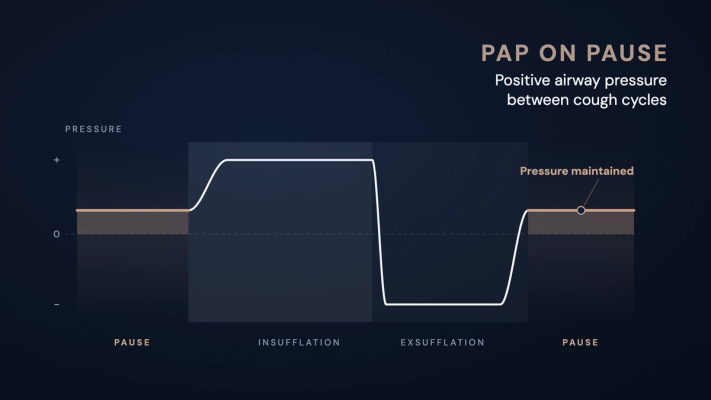
An additional feature, PAP on Pause (a pressure-holding phase between insufflation and exsufflation), maintains gentle pressure during a brief pause, according to the same comparison study, to stabilise lung volume between cough cycles [2]. The same study also reports that the device delivers consistent oscillations (vibrations) across both breathing phases, intended to support the movement of secretions [2]. The study is a bench measurement published by ABM (Seattle Children's Hospital) on a lung model, not a clinical investigation in patients; it describes what the device does technically, not what clinical effect this has in an individual case.
BiWaze Clear: lung expansion, secretion mobilisation and aerosol in one device
What you do at the device: You start the OLE cycle (oscillating lung expansion therapy), in which the lungs are first expanded and then set into vibration.
Why it works: BiWaze Clear addresses a different point than BiWaze Cough. According to the user manual, it is indicated for the mobilisation of secretions, for lung expansion therapy, and for the treatment and prevention of pulmonary atelectasis, and, when connected to compressed oxygen, can also deliver oxygen [3]. The mechanism of action is called Oscillating Lung Expansion therapy (OLE): according to the manufacturer, the device delivers three therapies in one, lung expansion, secretion mobilisation, and aerosol therapy [3].
The sequence, as described in the user manual: first the lungs are expanded through positive airway pressure (PEP, "Positive Expiratory Pressure"), then oscillation therapy (OSC) begins directly afterwards [3].
BiWaze Clear also comes with a built-in nebuliser (Aerogen vibrating-mesh nebuliser), which combines aerosol with continuous positive pressure to thin secretions and widen the airways [3]. To separate the airways, the device uses the Dual Lumen Breathing Circuit, which keeps the inspiratory and expiratory paths apart; on BiWaze Clear it is included as standard [3].
One point that concerns market approval: the user manual describes nebulisation with saline solution [3]. Which further medications may be nebulised is governed by the user manual applicable in each market and by that medication's own approval. If in doubt, we're happy to advise. In acute care, BiWaze Clear can additionally be connected in-line to a ventilator; in the home setting, it cannot [3].
The devices compared
| BiWaze Cough | BiWaze Clear | |
|---|---|---|
| Mechanism of action | Mechanical insufflation-exsufflation (MI-E), active pressure reversal | Oscillating lung expansion therapy (OLE), PEP + oscillation + aerosol |
| Problem addressed | Missing or too-weak cough | Secretion mobilisation, lung expansion, atelectasis prevention |
| Aerosol delivery | Not part of the core function per the user manual | Built-in vibrating-mesh nebuliser |
| Airway separation | Two separate blowers; separation in the tubing via Dual Lumen Breathing Circuit (accessory) | Dual Lumen Breathing Circuit (included as standard) |
| Use on a ventilator | – | In-line possible, acute care only |
Sources: BiWaze Cough [1] and BiWaze Clear [3] user manuals, bench study [2].
It's worth noting: this comparison describes two different mechanisms of action, not a ranking. Which device suits a particular patient depends on the underlying problem, not on which device "can do more".
Where both devices can make sense together
No fixed combination scheme can be derived from the respective user manuals; each device is described independently for its own indication [1][3]. In clinical practice, it does happen that a patient has both a cough deficit and a secretion/expansion problem; in that case, using both device types within the clinician's treatment plan can in principle be considered. Such a decision rests with the treating clinician and is not laid down by the user manuals.
What the documentation leaves open
Both user manuals describe mechanism of action, indication and technical features, but give no blanket recommendation for choosing between the devices in mixed clinical pictures. This decision remains with the treating clinician and is verified on the patient, not derived from a table.
Contact for practical questions
If your team is unsure which device suits which clinical picture, or if you would like on-site training with the device: get in touch. We're happy to arrange a product demonstration, on-site training, or contact with the specialist dealer responsible for your region.
Frequently asked questions
Can one device replace the other?
No. BiWaze Cough addresses the missing cough (MI-E cycle); BiWaze Clear addresses secretion mobilisation and lung expansion (OLE cycle). According to the user manuals, these are different mechanisms of action for different problems [1][3].
Can I also nebulise medications with BiWaze Clear?
Yes, via the built-in vibrating-mesh nebuliser. The user manual describes nebulisation with saline solution [3]; which further medications are permitted is governed by the user manual for the relevant market and by the drug's own approval.
Does BiWaze Cough have an aerosol function?
The BiWaze Cough user manual does not describe aerosol delivery as a core function; the device is designed for the MI-E cycle to support coughing [1].
Sources
[1] BiWaze Cough User Manual EU (Instructions for Use, EU, multilingual), Indikation, MI-E-Wirkprinzip, dualer Atemweg
[3] BiWaze Clear User Manual (Instructions for Use), Indikation, OLE-Wirkprinzip, Vernebler, Atemwegstrennung, US/CE-Regel Vernebler
Note
This article is provided for professional information and does not replace clinical judgement. Statements on device settings are orientation only; the device's instructions for use and the assessment of the treating clinician prevail.