


A good eye. But is it enough?
Anyone who fits masks regularly knows the situation: a brief look at the face, a few targeted questions, and one or two models already come to mind.
Most of the time this works remarkably well. After all, experience and a trained eye are not easily replaced.
But how objective is our assessment really?
Facial shapes differ, mask sizes are not standardised across manufacturers, and even within a single manufacturer's range, size specifications can vary considerably.
Digital measurement methods could offer additional orientation here. Instead of relying solely on experience and sizing templates, individual facial measurements can be systematically matched against available mask models.
The decisive question, though, is not whether we can measure a face digitally. It is what we then do with that information.
MaskFit AR: how does it actually work?
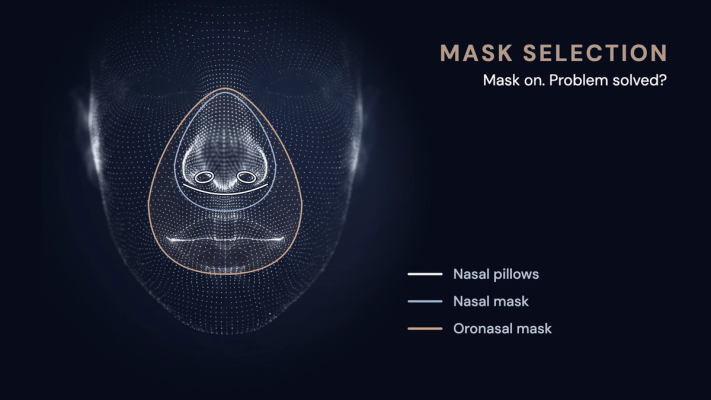
MaskFit AR is a software tool for clinical staff at homecare providers. Using a camera on a smartphone, tablet or webcam, it takes facial measurements and matches them against the stored size specifications of various mask manufacturers.
On this basis, the application generates a preselection of possible mask models and sizes. The final selection and the actual fitting remain the task of the qualified clinician [1].
The workflow itself is remarkably straightforward.
First, the clinician sets up a patient profile and records, alongside therapy mode and pressure settings, personal details relevant to mask selection. These include, for example, preferred mask types, sleep position, or possible limitations due to skin sensitivity or magnetic clips. A link for a remote digital facial measurement can then be sent. The application guides the patient through the individual steps and captures the required facial measurements.
Clinical staff then receive a shortlist of possible models and sizes, which they can review and use for further care.
The cross-manufacturer approach is particularly noteworthy here. Rather than being limited from the outset to a single product range, different models can be included in the preselection.
And there is another advantage: an initial preselection does not necessarily require an in-person appointment.
Especially with longer travel distances or short-notice care needs, this can considerably ease organisation. The application can also send the patient instructions on how to put on and adjust the selected mask.
But a digital mask recommendation is, to begin with, exactly that: a recommendation.
Measured is not the same as fitted
A facial measurement delivers information about anatomical dimensions. What it cannot directly assess is how the patient actually experiences the mask.
How does the material feel on the skin? Is contact on the bridge of the nose perceived as comfortable? How does mask fit change with movement or while lying down?
And above all: does the patient actually want to wear this model?
A digital result can help us narrow down possible models. Whether the proposed mask is suitable in the individual case still has to be assessed during the practical fitting.
This, to me, is exactly where the sensible limit of digital support lies: The technology can supply information. The decision still needs the human being.
And what does the patient actually say?
That patients experience mask therapy very differently is well documented scientifically.
In a 2025 qualitative study, 19 people with obstructive sleep apnoea were interviewed. Ten used their CPAP therapy regularly, nine used it little or not at all.
The results show how widely expectations and experiences can vary. Alongside difficulties with the mask and device, personal expectations, perceived treatment effects, the social environment and support from clinical staff all played an important role [2].
Some participants found it difficult to judge at all whether a mask had been fitted correctly. They simply lacked a point of comparison.
That is an interesting thought for digital mask preselection.
How does a patient's perception change when their face is measured before the actual fitting? Does this possibly create the sense that the selection was more closely tailored to their individual features?
We know such reactions from practice: patients sometimes report, quite convinced, that their mask has to fit, since their face was precisely measured beforehand.
Such an expectation can initially be quite positive. It may convey the feeling of having been cared for in a particularly individualised way.
But this is exactly where a challenge lies. The digital preselection is no guarantee of actual fit.
And what happens if the proposed mask then does press or feels uncomfortable after all?
Trust matters. But it must not lead to complaints being taken less seriously.
Whether MaskFit AR itself changes patients' expectations or trust has not yet been sufficiently demonstrated scientifically.
Well fitted. Better cared for?
How important a personal, structured mask fitting can be is shown by a randomised study from 2021.
A total of 156 patients with obstructive sleep apnoea were assigned to two groups. One group received an additional 30-minute mask fitting with hands-on training before starting home APAP therapy, while the comparison group received care as usual, structured variably, through a durable medical equipment provider.
138 patients were included in the final analysis. In the first month, the proportion of days with at least four hours of APAP use averaged 78.4% in the supported group, versus 67.8% in the comparison group [3].
The study did not examine MaskFit AR. But it illustrates what a difference structured clinical support can make.
Fewer trials. More time gained?
Beyond the clinical perspective, it is also worth looking at workflows at homecare providers.
A large retrospective analysis of German care data covered a total of 28,567 patients. In around 30%, a mask change was documented within the first year after starting CPAP, and a further 14% received a mask replacement [4, 6].
Of course, not every change means the original selection was wrong. Complaints, changing needs or wear can also play a role.
Still, this shows how much effort and cost can be involved in mask provision. It can take several models before a mask truly fits. And not every mask that is tried can simply be reused. Depending on the model, it must be properly reprocessed or discarded. Add to that further fittings, appointments and home visits. This costs time and money, and ties up staff.
Could a digital preselection help reduce the number of unnecessary fitting attempts?
Early experience from homecare practice suggests it can.
An employee of a homecare provider already working with MaskFit AR describes the application as a clear relief in daily work.
Instead of trying several models on a hunch, clinical staff can draw on a digital preselection. Based on his experience so far, this has meant fewer fitting attempts and simpler organisation of care.
He also notes an interesting observation regarding mask sizes: where he would, from experience, have reached for size M, the application repeatedly suggested a smaller size. And these sizes often did fit well.
This does not mean, of course, that smaller mask sizes are generally better suited. But it shows how a digital preselection can complement, and occasionally challenge, one's own judgement.
This is, of course, the personal experience of a single employee, not a systematic investigation.
A further insight comes from a practice report by NRI Medizintechnik. After one year with MaskFit AR, the company reports fewer trips and lower logistical effort [7]. This, too, is a practice report, not a systematic evaluation.
Still, this feedback points to where the potential added value might lie.
Fewer fitting attempts, shorter distances and more targeted material selection would be attractive benefits for homecare providers, particularly where staff resources are limited.
And if trips are indeed eliminated as a result, fuel consumption and the associated CO₂ emissions fall alongside travel costs.
A digital application becomes economically interesting above all when it genuinely simplifies workflows and reduces the effort involved in repeat provision.
Who decides which mask makes the list?
How independent is mask selection, really?
In homecare in particular, many providers work with fixed mask ranges. Some even distribute their own products. That, in itself, is entirely normal.
It could become problematic if availability or commercial interests weigh more heavily in mask selection than the individual needs of the patient.
A cross-manufacturer digital preselection offers the possibility of widening the view to different products.
This, however, requires that the manufacturers, models and sizes on file are sufficiently comprehensive and up to date. The criteria behind the suggestions should also be traceable.
Manufacturer independence is therefore an interesting approach. Whether it actually leads to a broader selection in a given care process has to show in practice.
Progress, or just another screen?
Digital methods for mask selection are not an entirely new idea. Already in 2021, a system was presented that captures faces in three dimensions, matches them against digital mask models, and even calculates possible pressure points [5].
That sounds promising. However, a different system was studied there, not MaskFit AR.
And what about scientific evidence? A 2025 commentary points out that the information available so far on digital applications for mask selection frequently relies on manufacturer data and so-called white papers [6].
This does not mean such applications are without benefit. The positive experience from homecare practice does speak to their potential. But we still need to distinguish between good practical experience and scientifically demonstrated results.
An extra screen does not automatically make care better.
But if it spares us unnecessary journeys, repeat fittings and additional work, it can indeed offer real added value.
It is not the software that decides. It is us.
Digital facial measurements can be a useful additional building block in mask selection, particularly where they help narrow down possible models more systematically and question habitual selection patterns.
Practical experience so far shows that such applications can ease everyday care organisationally.
How large the actual savings are, and under what conditions they arise, should however be investigated further.
And the patient?
They should not become the passive recipient of a digital result. Their experience, wishes and feedback still belong at the centre.
Perhaps the future of mask selection does not lie in choosing between experience and technology.
But in combining the two sensibly.
Frequently asked questions
What is MaskFit AR, and how does the digital mask preselection work?
MaskFit AR is a software tool that matches facial measurements against the size specifications of various mask manufacturers. This produces a preselection of possible mask models and sizes. The final selection still rests with clinical staff.
Can the facial measurement also be carried out from home?
Yes, a digital facial measurement can be performed remotely via a link sent to the patient. The application guides them through the individual steps. Clinical staff can then review the suggested mask models and organise further care.
Can MaskFit AR reduce fitting appointments and home visits?
Early experience from homecare practice reports that the more targeted preselection means fewer mask models need to be tried. This can simplify workflows and avoid additional fitting appointments or travel. How large the actual savings are depends on the individual care process.
What happens if a patient struggles with the digital facial measurement?
Not every patient is familiar with digital applications or able to carry out a measurement independently. In such cases, personal support from clinical staff remains important. The conventional mask fitting process also remains available.
Does a digital facial measurement guarantee that the proposed mask will fit?
No. Facial measurements can support the preselection, but they do not capture how the mask feels to the patient. Comfort, handling and individual preferences still have to be considered during the actual fitting.
Should this article deviate from the manual, the manual applies. Guidance on selecting settings does not replace clinical judgement.
Note
This article is provided for professional information and does not replace clinical judgement. Statements on device settings are orientation only; the device's instructions for use and the assessment of the treating clinician prevail.